

.png)

RETTENDON 30 YEARS ON: Denials from Billy Jasper and Mr D as 'bombshell' deathbed letter emerges

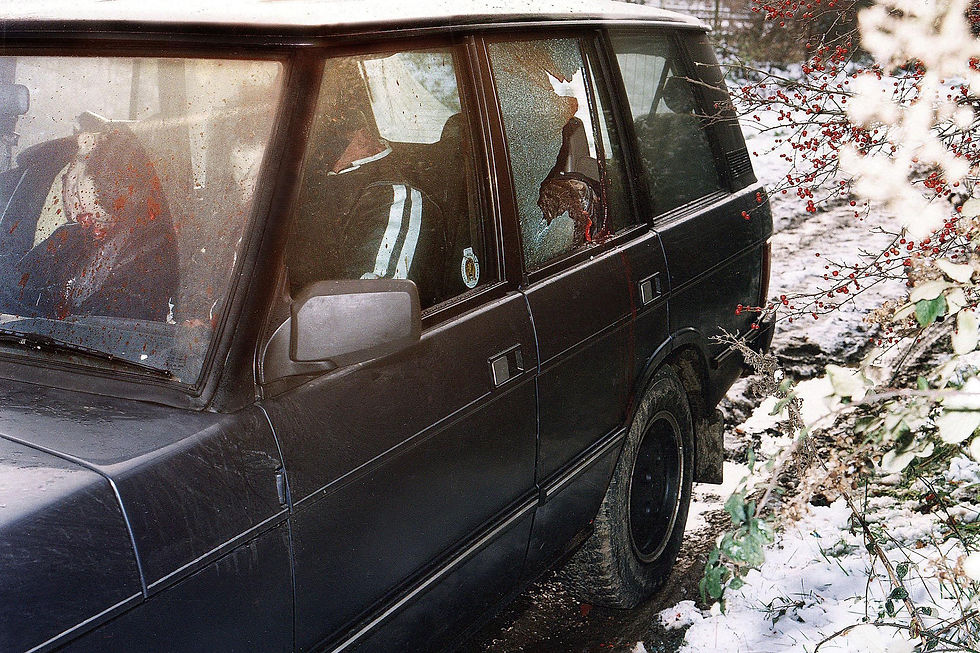
THIRTY years ago today the bloodied bodies of three drug dealers were found in a Range Rover on an isolated snowy farm track near Basildon.
Pat Tate, 37, Tony Tucker, 38, and Craig Rolfe, 26, (below left to right) had been lured to the location in Rettendon before they were ambushed and shot dead with pump action shotguns.
The grisly executions on December 6 1995 put Essex on the map again for all the wrong reasons less than three weeks after headlines about the death of 18-year-old Leah Betts.
Her parents provided pictures of her unconscious in a hospital bed after she became ill after taking ecstasy scored from Basildon nightclub Raquels, linked to the dead men, who were alleged to have been involved further up the chain in the drug's supply.

In the years since two men - Jack Whomes and Michael Steele (below left to right) - were tried and convicted of the murders.
Just over five months after the killings Essex Police arrested the two as prime suspects for the triple murders after a criminal associate, who was arrested over a cannabis importation agreed to turn supergrass to testify against them.
Darren Nicholls, who was involved in drug supply with Whomes and Steele, later told the Old Bailey he had driven the former to the country lane, before leaving him there while he waited for his accomplice to arrive in the Range Rover with the three victims.
It was alleged the murders happened after Steele and Tate fell out over a cannabis deal, with the former luring the three men to their deaths on a bogus pretext of showing them a drop off site for a smuggling job by his plane.

It is believed that after Steele, now 83, got out of the vehicle to open a gate, he was joined by Whomes, 64, with the weapons before the pair set about their bloodbath at just before 7pm.
After the jury heard Nicholls' account, that he then returned to a nearby spot to drive them away, and of new mobile phone cell site evidence that put Whomes and Steel in the area at the time, the two defendants were convicted of the murders and each jailed for life in January 1998.
They have even served their time and been released in 2021 and earlier this year respectively.
The pair profess their innocence, but draconian parole terms mean they cannot speak to the press as part of any bid to clear their names.
In the 30 years just passed there have also been a series of books written about what is arguably Britain's most notorious gangland murders and a plethora of movies about or based on the assassinations, including the 2000 film Essex Boys starring Sean Bean, and the Rise of the Footsoldier series from 2007.
Several Facebook groups dedicated to discussion about the case have also emerged and grown in numbers over the last 15 years.
They are split into two rough camps - those who believe the wrong men were convicted and there is more to this murky case than meets the eyes - and those who say Whomes and Steele are guilty and a line should be drawn under it.
Bernard O'Mahoney, 65, the former Raquels doorman and associate of Tate, Tucker and Rolfe, is now firmly in the guilty camp.
This month he published a further six new books, entitled Complete Story of the Essex Boys 1 to 6, about the case, which cover the whole saga, including his change of view.
He had campaigned they were innocent alongside Whomes' brother John Whomes, who died aged 62 in November 2024, for years, until a change of heart during production of the 2015 Revelation Films documentary Essex Boys: The Truth.
It was after John Whomes allegedly admitted his brother was guilty and was then secretly recorded saying he had nobbled the late prosecution witness Barry Dorman, a friend of Tate's.
Also in the guilty camp is former Essex detective inspector Paul Maleary.
He said after details of the recording emerged it was “time to draw a line” under the debate about the convictions of Whomes and Steele and "accept the right men were convicted.”
Fiercely opposing this view is a team of former murder detectives at private investigation firm TM Eye, who have worked on the case pro=bono for the last few years, and are convinced it is a major miscarriage of justice.
Their report which claims to have proved Nicholls lied under oath and says the whole case is mired in corruption was the trigger for the latest review of the convictions by the Criminal Case Review Commission.
With no outcome on that as yet, speculation about the case is unlikely to end with no line being drawn.
A CCRC spokesperson said: “Applications have been received in relation to these individuals, and a review is currently underway.
“It would be inappropriate for us to make any further comment while the applications are under review.”
Former Met Police DCI Dave McKelvey, who runs TM Eye, which submitted the report to the CCRC, claims to have proven Nicholls lied in his evidence and has alleged the case was mired in police corruption.
His most startling claim was made late last month<November>after a former prosecution witness allegedly left a deathbed letter which claimed police had pressured him into editing Telewest phone evidence for the case.
Mr McKelevey posted on Facebook: "Now, the TM Eye Murder and Serious Crimes Review Team has revealed a piece of evidence that changes the entire landscape of the case.
"This is the story of Lee Shaw, a young Telewest engineer in 1995. A man who never appeared in the headlines, who said nothing publicly, who kept his silence for almost thirty years. But before he died, he left behind a final message — a dying declaration — that he wanted delivered only after his death."
In 1995 Lee Shaw was an engineer aged in his 20s for phone company Telewest, in Basildon, which held telephone data that was used in the triple murder investigation.
Mr McKelvey said before his death, Shaw wrote a "dying declaration" which was allegedly handed sealed to Lee Mayo of YouTube documentary channel Liquid Bullet Productions, with the instructions: “Open this only after I’m gone."
Mr Mayo had been friends with Mr Shaw, who died a year ago, for a number of years, and is said to have been filmed opening the sealed letter.
He wanted it given to retired Albert Patrick, former Commander of the Met Police Flying Squad, who is now on the TM Eye review team.
In the letter, Shaw allegedly stated that outside of work he had been involved in minor car crime and Essex Police detectives who came to the firm asking for phone data in connection with the investigation made it clear to him they knew about this.
He went on to allege that the officers asked for evidence to be manipulated and he did it as he was scared of otherwise being prosecuted.
He allegedly said they also made him fear two ruthless killers could remain at large if they could not secure the "evidence" to prosecute them.
He went on to claim he had lived with the guilt for years but was too scared to reveal all before his death.
Mr McKelvey is convinced it could be a turning point for the investigation and has passed it to the CCRC.
He said: "For years, the TM Eye review team has argued that key telephone evidence in the original case was changed, removed, or 'lost' in ways that made no sense. Patterns didn’t match. Call logs didn’t fit the physical reality. Whole sections of data simply vanished.
It looked manipulated — but no one could ever prove who did it, or why.
"If Shaw is telling the truth, then the original Telewest evidence was interfered with and the chain of evidence was compromised."
But, Mr O'Mahoney, posted on his Facebook page that a comment he left in response to the Lee Shaw revelation from TM Eye was deleted and he reposted a screenshot on his page.
He wrote: "Phone evidence has two parts: the caller and the receiver. I've read Shaw's statement. It appears to me there was an error typing the number from the itemised bill to the statement.
"Human error is not corruption.
"It will be interesting to see or hear just how this could change anything and why officers would put it on a 23 year old telephone engineer/worker who was being instructed by his boss."
He also questioned the 12-month gap between Mr Shaw's death and the letter surfacing.
One poster on Mr O'Mahoney's page asked: "Are they going to produce this letter for people to read to see if it is actually genuine?"
Another development that will keep interest in the case alive was an October podcast in which a key person spoke publicly for the first time about his involvement.
Mr McKelvey has previously said he believes Essex Police should have investigated more thoroughly the account of east End criminal Billy Jasper (top image on the podcast), who claimed to have been the driver for a different killer (Mr D), four months before Nicholls came forward in January 1996 after he was arrested by the Met Police on suspicion of an unconnected robbery.
Mr Jasper wrote a 12-page handwritten statement confessing his role and naming the alleged killer, Mr D, before he took officers to where he said he dropped him off near the murder scene and then did recorded interviews with police.
Mr Jasper went on to give evidence for the defence at Whomes and Steele's trial, when he maintained his account.
In October, he spoke about the case for the first time since the trial in an interview with podcaster former drug trafficker Shaun Attwood.
Mr Jasper denied writing the statement or taking part in recorded police interviews, claiming an actor must have pretended to be him.
He admitted cooperating with police and going with them to near the murder scene, claiming he made it all up to trick officers into thinking he was cooperating in the hope of a lighter sentence for the robbery.
Mr McKelvey said: "His denials are utter rubbish. He wrote the statement. He also claimed it was an actor in the police recording, although he went on in the podcast to admit he did give evidence at the Old Bailey, and that was based on what he had said in the police interview so his denial makes no sense at all."
Mr O'Mahoney has also released this month a trailer for an interview he is said to have carried out with Mr D in 2023.
In the audio recording Mr D insisted he had never seen the three victims or Whomes and Steele in his life.
Of claims he was the killer, he said: "(It's) total, total rubbish. If it wasn't so serious I would just be laughing. The only thing I know is I wasn't there. It is too silly for words."
Essex Police was asked if it was aware about the new claims around Lee Shaw.
An Essex Police spokesman repeated a statement it has given several times when asked about the case in recent years.
He said: “There has been an exhaustive police investigation into the murders of Pat Tate, Tony Tucker and Craig Rolfe in Rettendon on 6 December 1995, which resulted in the conviction of Michael Steele and Jack Whomes for their murder.
“Since then, this case has been back before the Court of Appeal twice, in 1999 and 2006.
“These appeals have included focus upon key evidential aspects of the case. Both appeals were rejected and in 2006 Lord Justice Kay commented that there was no ‘element of unsafety’ relating to the original convictions of both defendants.
“This case has also been examined exhaustively by the Criminal Cases Review Commission (CCRC) over the last 30 years.
“We will of course always work with the CCRC and keep any new information under review.”
But, the force's insistence is unlikely to end speculation any time soon, certainly not while the CCRC application remains outstanding, the Facebook pages remain open and following the release of Mr O' Mahoney's new books.